
Leadership at Meetings
 I don’t remember a time when I wasn’t drawn to rules for appropriate social and civic interaction, whether in my consular or professorial role. Perhaps this comes from a Scandinavian culture that valued polite conformity and an upbringing steeped in matters of etiquette and protocol. Perhaps it has something to do with my training in the civil law system and its anchoring in written provisions.
Regardless, I became an expert in the rules for the democratic decision-making process (“parliamentary law and procedure”) in non-profit organizations and membership associations. I used these skills both as a leader myself (i.e. as president) and as a contributing member of many organizations (knowing that ultimately it’s the majority opinion of members that prevails).
Among the organizations where I served in both roles, I like to mention ZONTA International; the Finnish-American Chamber of Commerce; AALS (Association of American Law Schools) Section on Graduate Programs for Foreign Lawyers; Florida State Commission on International Education; and NAFSA: Association of International Educators. Also, I’m particularly proud over my service as national parliamentarian for two truly outstanding organizations: NAFSA and NCJW: National Council of Jewish Women.
Some people see how rules can be comparable when used for conducting meetings and when applied to consular etiquette and protocol. If so, I applaud you. It’s all about civil behavior in sometimes confusing circumstances.
At events attended by consuls in their official (not private) capacity, it's helpful for "a leader" - governmental or private - to know what code of conduct is expected. Scroll down https://chofstadter.com/consular-publications/ to information on the Florida State Handbook.
In the Bar
For several years I also taught members of the Bar during its leadership days how to conduct a meeting in the most efficient way while using the democratic process of majority rule (How To Conduct a Meeting According to Robert’s Rules of Order and in View of Recent Case Law, Section and Committee Leaders Handbook, Florida Bar, beg., 1989). Lawyers in leadership positions can showcase democracy in action when modeling proper meeting procedure.
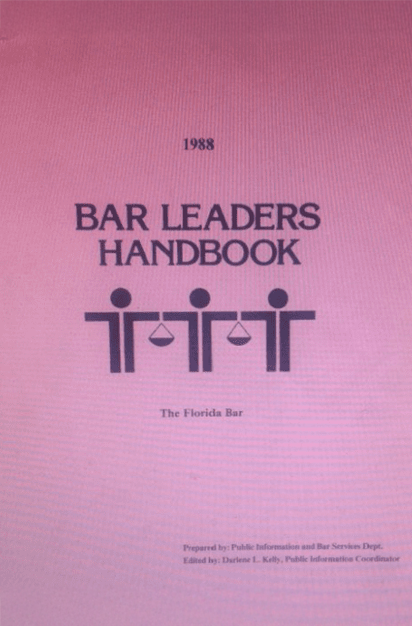
Bar Leaders Handbook, 1989
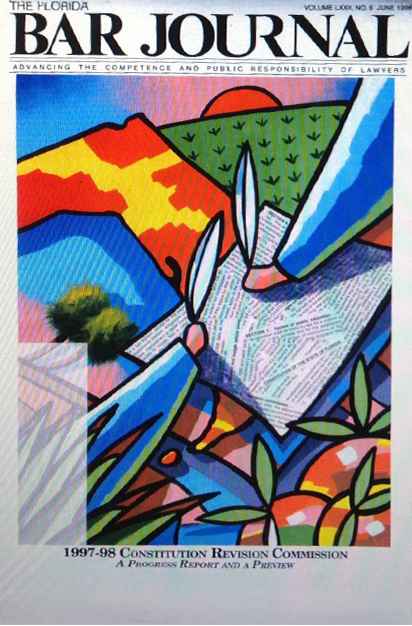
Florida Bar Journal, 1988
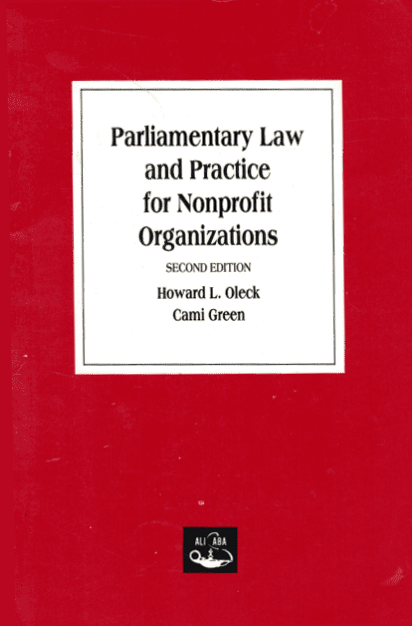
Parliamentary Law and Practice for Nonprofit Organizations, 2d ed., 1991
Students of the late Prof. Oleck contributed to the 1st edition of this book, but it soon became apparent that a major revision/update was needed. Although the 2d edition, of which I am the sole author, is no longer in print a few copies may still be available by contacting me. Originally devised for those in the legal profession, the book is also useful for “friendly” membership organizations where a decision is at risk of being challenged in a court of law.
Since I believe that majority rule in meetings should be learned from an early age, so that future leaders will know how to reach decisions in an efficient manner that’s determined by a majority protecting the rights of the minority, I have fond memories of hands-on classes at many high school service clubs. I also worked with the Honors College at Miami Dade College, sororities and fraternities at the University of Miami and Florida International University, to mention just a few.
Some people see the similarities between how individuals conduct themselves in meetings and in circumstances invoking consular etiquette or protocol If so, I applaud you. It’s all about civil behavior in sometimes confusing or challenging circumstances.
Samples of Other Writings
Betwixt’N Between PIL and PLP: The Public Interest Lawyer and Decisions in Nonprofits
LXXII Florida Bar Journal No. 6 (June, 1998). Again, I draw attention to the fact that lawyers should be more proficient in the majority-based decision-making process; not just for their own protection but so that they can counsel clients.
A Quorum Problem in a Labor Union
51 Nat’l Parl. 3 (4th Quarter, 1990). Even though I discuss a dilemma in a labor union, the matter of a “quorum” is so commonly misunderstood that any reader can relate to my essay.
So You’re Afraid of General Robert?
31 University of Miami Veritas 6 (1990). During many years of consulting work, I became quite familiar with the common fear of Roberts Rules of Order. In this story I talk about that unfounded feeling.
Why Can’t Lawyers Be More Like Us?
XXXVI Parl. Journal No. 4 (October, 1996). A little bit tongue-in-cheek, I write about how law schools don’t teach parliamentary law and procedure and, yet, we look to the legal profession for advice on when a decision has been made in a way that stands up to a legal challenge.
Number One Question
“Why do you use the words parliamentary law?“
I know how scary this seems to some people. Others, like members of the legal profession, seem to resent when non-lawyers toss this term around. Take, for instance, college students or members of a garden club: who are they to be talking about law? So the thinking goes. But there is a reason why this term is still in usage. In one single word, the history.
In 1863, when General Robert put together a pocket manual of rules of order for meetings, he considered those used by the old British Parliament for reaching a decision. Obviously, there was a need for some sort of rules-book because his became a best-seller and is still with us (in updated editions) although many other authors have tried to simplify and change what the Brigadier General initially proposed.
 Today, we know from case studies that judges frequently disregard Robert’s Rules, even when it’s the adopted authority in an organization. Instead, the courts will consider violations of an individual’s rights under constitutional and state law provisions. I, too, side with groups looking for a substitute for the term parliamentary law but what can we use instead?
How about majority-based decisions? Too long and cumbersome?
How about modernizing it to the acronym PLP while recognizing the history of parliamentary law and procedure?