
My Path
My personal diaries (all seventy of them) bear testimony to my life-long fascination with language and writing, as I began journaling in my native tongue, Swedish, when I received my first diary for my sixth birthday.
At the age of seven, I wrote my first two “books.” What strikes me about The Baker and his Wife is how I, at such an early age, knew that laughter was too frivolous for our little world (and this was decades before Finland became the happiest country in the world!). When the baker gets a large order for sweet rolls, he breaks into a cheery song but the patrolling police officer steps into the store to tell him to be quiet because he’s “disturbing” everybody.
The other book from the same time, The Troll in the Woods, is all about that sweet mythical being who didn’t know how to perform magic like the rest of the trolls. My father helped me illustrate the cardboard covers that held the frayed pages of both books together. On the back, I penciled “written by the world-famous authoress,” – perhaps not an uncommon goal of a young girl who discovered the pleasure of creating through the written words.
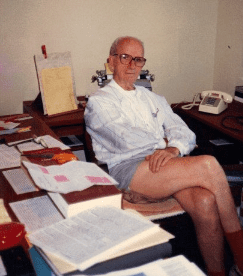
Later in Miami, where all of my diaries (around eighty today) moved with me, I had the good fortune of interviewing James Michener (yes, he of worldwide fame) for the major Swedish-language daily in Finland.
I shared that little tidbit about my grandiose dreams with him. As our visit ended and he walked me to the door of his home, his otherwise somber face broke into a mischievous grin.
“This is the first time my threshold has been crossed by a world-famous authoress,” he said. And we laughed in unison.
The Road Forward
Maturity has since given me a more balanced grip on reality, but I’ve never stopped writing. Although I grew up in a culture where compliments were few and far between, my high school writing teacher was an exception. His praise – that my pen was a divine gift (“gudabenådad” for those who’re interested in the original language) – kept me going throughout the years, despite the usual snickers by my classmates echoing in the background.
After my early human interest narratives, I started pursuing my research interests (the Holocaust years in Scandinavia, and the nature of foreign consuls), in many instances finding an overlap of the two. And sometimes I stumbled on the many humorous ways in which non-human consuls were used in marketing and promotion. One example is when Ford Motor Company first introduced its Consul brand of cars in England in 1950.

Ford Consul
Although I no longer seek fame and fortune, it's obvious that the two genres on which I now focus my speaking and writing interest - non-fiction and fiction - aren't mutually exclusive. I believe stories will always continue to be our legacy as human beings, regardless of the main topic. As author Oliver Sacks said, stories are fundamental to our identity.
With a consulate being the term for a consular office, a consul is a person, a living individual who may be the subject of human-interest stories. For instance, there were the ones about a soccer-loving consul and the avid ballroom dancer who died on the dance floor of a heart attack.
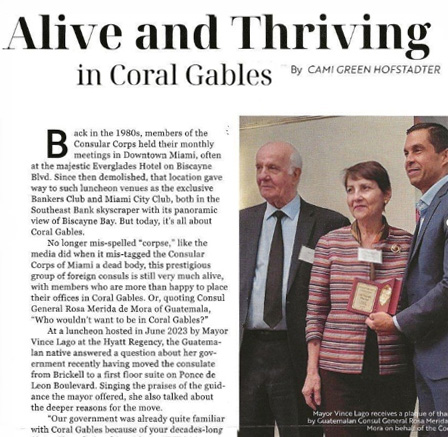
For an added human-interest aspect of a consular topic see:
City Beautiful, Edition 2023-2024 (Alive and Thriving). Coral Gables Chamber of Commerce
Today, it seems consuls are mostly featured for their official functions, not only for their spare time activities as in the past. See, for instance, Local Consuls are Bridges to Foreign Economies (2015) https://www.miamiherald.com/news/business/biz-monday/article45700416.html.
Also, click on More publications for more from My Consular Pen.