
My Consular Pen

While I juggled several different hats throughout my career, other lawyers – some of whom were honorary consuls themselves – shared how they lacked an understanding of their role so that led me to pen a law review article with a practical viewpoint: Counsel, Consul, or Diplomat: Any Practical Significance for Practitioners? 1 U. Miami Int’l & Comp. L. Rev. 143 (1991), available through the law library at the University of Miami (https://repository.law.miami.edu)
In 2015, while a member of the Consular Corps College, Washington, D.C. http://www.consular-corps-college.org/ I also wrote a piece for its now-defunct Forum Magazine (No 4).
 The Corps has long been featured in a variety of trade and business related publications. "Distributed throughout the Americas, Global Miami is a monthly print publication and real-time digital platform..." Cami Hofstadter's (my) piece appeared in the Dec. 2023 issue.
As it's commonly said, it’s all about education. To that end, I surreptitiously climbed onto my educational soap box when I created and published a monthly column for almost ten years: Esprit de Corps, for Miami Today – the Newspaper for the Future https://www.miamitodaynews.com
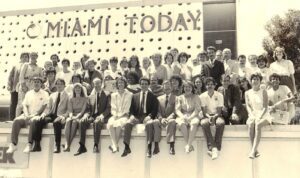
Writers (like myself) and staff on the roof of Miami Today, 1985
Ostensibly, my purpose was to chat about the activities of our local consuls but I often included a mention of terms and titles most frequently misunderstood by the media or fellow consuls. Surprisingly, it wasn’t terminology that sometimes upset an ignorant colleague or newspaper reader but rather the fact that I didn’t include something generally belonging on the social pages (like who attended what event and the formal outfit of a spouse).
As an incessant note keeper, I kept track of the many business, civic, or official situations where the position of a foreign consul was misunderstood or their presence ignored. Several topics of common concern kept repeating themselves - still do - in my now-bulging file: Why are there so many different consular titles? Should these officials be recognized differently when they serve in a career or honorary position? Can civic and business leaders and state officials actually benefit from having this knowledge?
Coincidentally, state officials were deliberating these matters at the same time, in the context of what follows below:
Etiquette & Protocol

Practical Protocol for Floridians
In tying Florida's international identity to the foreign consuls functioning within it, George Firestone (Secretary of State 1978-87) is often credited with the revision of the outdated handbook on state protocol – Practical Protocol for Floridians – to reflect emerging globalism in the areas specifically defined by him: trade and culture. Although some U.S. states occasionally revise any existing guides to state protocol, they don't always consider the foreign consuls in their midst.
When Allen Morris, official state Historian and Clerk of the State of Florida asked me to add a comprehensive chapter on consular protocol, he also requested other helpful tools for anyone interacting with them. Hence, this book includes the role of the foreign consuls in our communities. In an official letter, Mr. Morris then credited me for filling the existing void with practical and accurate advice.
Long before I responded to Mr. Morris's request, I had been fielding queries from out-of-state places around the country with an already-existing consular presence. After the publication of the state handbook, I was told this caused a surge in requests for copies, if only just for the consular chapter.
My own book, The Foreign Consuls Among Us: Local Bridges to Globalism further explores the interrelationship between protocol and etiquette. The latter is quite available in traditional etiquette books, usually guided by social customs. For instance, most of us know how to introduce people to each other.
Consular protocol on the other hand (not to be confused with the protocol for diplomatic receptions in our nation’s capital), is based on a ranking system established by the Vienna Convention only for career heads of post. In reality it’s difficult (often impossible) in our communities to quickly and efficiently determine what consul outranks whom.
Crossing Bridges
Although I’m an international lawyer by training, not a historian, one of many consular bridges I have crossed is the one leading to the history of the Holocaust years in Scandinavia. Such was the time when I was asked, in my consular role, to find a Miami rabbi willing to repeat the 1943 sermon given in Copenhagen as a message for congregants to go into hiding.
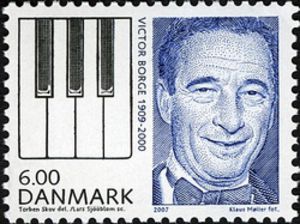
Honored with a stamp by his birth country
The surprising request was co-signed by Victor Borge, that comedic fall-off-the-chair pianist from Denmark whom I had adored since I was a little girl in Finland. A Jewish Dane, he fled to America in 1940, where he (along with a prominent NYC attorney, Richard Netter) founded an organization in 1963 http://www.thankstoscandinavia.org/.
This non-profit (“TTS”) perpetually honors the rescue of Scandinavian Jews through scholarships that remain a “symbol of gratitude for the past and a concrete contribution to our common future.” I greeted one such grantee from Copenhagen who was on the same graduate track (M.C.L.) at the University of Miami Law School, as I had been many years earlier.
Today, TTS is an Institute of the American Jewish Committee http://www.ajc.org/, the leading global Jewish advocacy organization which has built a strong "consular bridge" to the Consular Corps of Miami.
Indeed it was my consular position of years ago that launched my interest in Jewish history and the fight against anti-semitism. For several years, I was a judge in high-school essays on the topic and, as stated elsewhere on this site, I'm continually presenting in the area of war-time Jews in Scandinavia.